Some Intriguing Aspects of Quechua
details on a number of particularly intriguing aspects of Quechua’s
sound and grammatical systems,
and its relationships with other languages (Spanish and Aymara)
This page is intended
primarily for linguists,
so if you’re not familiar with linguistic terminology you may find it gets a
bit technical in certain parts. If so,
instead you might like to try these other pages, which are a bit more
layman-friendly than this one:
• my general webpage on an Introduction to
the Indigenous Language of Latin America, including a fair amount on Quechua.
• a
more
general introduction to the language, its geographical, social and historical context, here
• the presentation of Quechua (Ayacucho dialect) on Mark Rosenfelder's webpage at http://www.zompist.com/quechua.html.
This presentation discusses in detail mainly the Cuzco-Bolivian
dialect of Quechua, but
covers also many general features common to all dialects.
In places on this page I have had to use the symbols of the International
Phonetic Alphabet (IPA),
and wherever I have, the symbols appear as text in this shade of green, and within square brackets [like this].
These are in the Arial Unicode font, which most computers already have
installed.
What is Quechua
Like? A First Impression
Sound
System (Phonetics and Phonology)
Grammatical
System (‘Morphology’ and Syntax)
Quechua’s
‘Agglutinating’ Structure
 Quechua Word Structure – Sample Quechua Texts
separate
page with full analysis of the Quechua words
Relationships
with Other Languages
Back to Contents – Skip to Next Section: Sound System (Phonetics and Phonology)
1. What is Quechua Like?
To start with, a first impression of what Quechua looks and sounds like: two samples. Both are in the Cuzco-Bolivian dialect, which is also the dialect discussed in the whole of this presentation, except where explicitly stated otherwise.
1.1. An Old Quechua Play
The first sample of Quechua is from a rare old play, most likely composed in the first or second century after the Spanish conquest, Atau Wallpay P’uchukakuyninpa Wankan – “Tragedy of the End of Atahualpa”, the last Inca ‘Emperor’ captured by the Spaniards and then imprisoned, ostensibly for ransom (see also my bibliography page). This was to have his prison cell filled up once with solid gold and twice with silver, which his people duly did; the conquistadores then put him to death anyway. What follows are his opening lines in the play.
In the published version the text is spelt according to just one of the competing orthographical norms for
Quechua: the Bolivian version of
one author’s interpretation of the five-vowel (‘pentavocalic’) spelling
system (back to this later), very ill-suited to native Quechua, but popular
among bilinguals in Spanish. Here the
text has been standardised to the now official spelling system in
Pronunciation
Key:
• <h> after a consonant (except <c>) is a so-called ‘aspirated’ consonant, pronounced somewhat like that consonant with a forceful English [h] sound immediately after it.
• apostrophes after consonants denote ‘ejective’ pronunciations of those consonants, an even more forceful sound, unusual for European languages
• <ch> is pronounced as in English and Spanish = [tS] – though note that this too can be aspirated: <chh> = [tSH]
• the rest of the spelling is pronounced as is Spanish, i.e.: <j> = [h], <ll> = [´], <ñ> = [ø]
• <i> is pronounced more like [e], and <u> more like [o], where they occur in contact with <q> or <j>. Click here for more details.
|
Sinchiq munasqaykuna, |
My dearly beloved |
|
Wamra ñust’akunallay, |
Young princesses, |
|
nanaq llakiypimim sunquy, |
My heart is in grievous pain, |
|
ukhuymim llaqllapayasqa, |
My inside gnawed away, |
|
yuyayniymim chinkasqanña. |
My reason fled. |
|
Uk llakiytamim paqarini. |
I have woken to suffering. |
|
Imarayku kunan tuta |
For this night past |
|
muspayniypi yananchani |
In my sleep I was racked |
|
llaki phutillatataqmi, |
By grievous affliction, |
|
musquyniypiri rikuni |
In my dreaming I have seen |
|
Inti, maylliq Taytanchikta |
The Sun, our purifying Father, |
|
yana q’ushñinpi pakasqata, |
Hidden in black cloud, |
|
llapa hanaqpachatari |
While all the heavens, |
|
llapa urqukunatawanri |
All the mountains, |
|
puka puka rawrasqaqta |
Blazed so red |
|
pillkukunaq qhaqunta hina. |
Like the red in the breasts of the Pillkus. |
1.2. Modern Colloquial Quechua
This second example is a modern one, from broadly the same
dialect. It is a transcription from an
‘interview’, taken from the Autobiography of
Gregorio Condori Mamani.
Borrowings from Spanish appear in bold. Again, the
spelling has been adapted to the reformed and now official alphabet – for more
details click here.
Chhaynam vida kachkan. Ignoranciallaypim nini: chay Taytachap llagankunataq chhaynaniraq nak’ariypaq causa, tawa p’unchay vidapaq … chayqa, imanaptinmi mana maskhapachu hampirunku? Ña watakunaña
chhaynata warmiyta nirani, paytaqmi niran:
– Chaypaqsi extranjero mama Killata rin.
Chaypaq hinataqmi chay p’unchaykuna lliw callekunapi rimay kan, gringokunas avionpi semanantin purispa mama Killaman chayanku, nispa. Ñuqamanta rimayllachu si no
kanman.
My (fairly literal) translation:
Such is life. In my ignorance I say: if the wounds of this God are the cause of so
much suffering, for four days of life… Why don’t we look for him and treat him?
That’s what I said to my wife years ago, and she replied:
– They say that’s why the foreigners went to the Mother Moon.
In fact, just in those days, in all the streets there was talk of how the gringos, travelling for a week in a plane, had reached the Mother Moon. All that sounds like just tall stories to me though.
Phonemic
Transcription
The phonemic transcription matches very closely with the official standard orthography used, the only exceptions are the suffixes which have a morphemic spelling in order to ensure a consistent spelling is possible over all dialects of southern Quechua: in this text these are: progressive <chka> Cuzco [Sa]; direct evidence <m>, in Cuzco [n]; genitive <p>, in Cuzco [X].
Allophonic variation in of course not shown in this phoneMic transcription, but see the phoneTic
one below for this. The main allophonic
variants to be aware of is that syllable‑final stops are fricativised,
and /n/ before velars is [N]
like English <ng>.
Also, [e] and [o] are best analysed in native Quechua as allophones of /i/ and
/u/ respectively, and there are fierce (often not very informed) arguments
about how they should best be written (for more details, click here). The only occurrences of [e] and [o] in this
text are in borrowings from Spanish, except in the pronoun I <ñuqa> (official standardised spelling),
which in this
The Spanish loanwords are transcribed here in their original Spanish forms as conceived of by a fluent bilingual, with no adaptation to Quechua pronunciation. In reality, non-fluent speakers would tend to a greater or lesser extent to convert Spanish [e] to [i], and [o] to [u] in all the cases below, and for Quechua-speaking monolinguals [e] and [o] lose phonemic status entirely.
The phonemic transcription below in green is in the International Phonetic Alphabet (IPA). First the image file so that everyone can see it, then the text in case people want to copy and paste it. The text symbols can only be viewed properly with the SILDoulosIPA font (to see how to get this to work on your computer, click here).
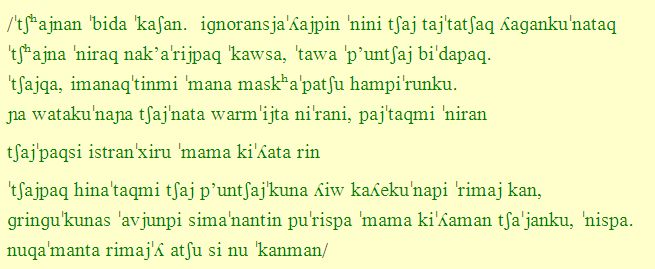
/ÈtSHajnan
Èbida ÈkaSan. ignoransjaÈ´ajpin Ènini
tSaj tajÈtatSaq ´agankuÈnataq
ÈtSHajna Èniraq nak'aÈrijpaq Èkawsa, Ètawa Èp'untSaj biÈdapaq.
ÈtSajqa, imanaqÈtinmi Èmana maskHaÈpatSu hampiÈrunku.
øa watakuÈnaøa tSajÈnata warmÈijta niÈrani, pajÈtaqmi Èniran
tSajÈpaqsi istranÈxiru Èmama kiÈ´ata rin
ÈtSajpaq
hinaÈtaqmi tSaj p'untSajÈkuna ´iw ka´ekuÈnapi Èrimaj kan,
gringuÈkunas Èavjunpi simaÈnantin puÈrispa Èmama kiÈ´aman tSaÈjanku, Ènispa.
nuqaÈmanta rimajÈ´ atSu si nu Èkanman/
Below is a phonetic transcription showing major allophones. Allophones of /i/ and /u/ often show finer distinctions than those transcribed here, though with considerable variation. Again, first the image file, then the text.

[ÈtSHajnaN
Èbida ÈkaSaN. ignoRansjaÈ´ajpiN Ènini
tSaj tajÈtatSAX ´agaNkuÈnatAX
ÈtSHajna ÈniRAX nak'aÈRijpAX Èkawsa, Ètawa Èp'untSaj biÈdapAX.
ÈtSaeqa, imanAXÈtiNmi Èmana maskHaÈpatSu hampiÈRuNku.
øa watakuÈnaøa tSajÈnata waRÈmijta niÈRani, pajÈtAXmi ÈniRaN
tSajÈpAXsi estRanÈXeRo Èmama kiÈ´ata RiN
ÈtSajpAX
hinaÈtAXmi tSaj p'untSajÈkuna ´iw ka´ekuÈnapi ÈRimaj kaN,
gRingoÈkunas Èavjompi semaÈnantiN puÈRispa Èmama kiÈ´amaN tSaÈjaNku, Ènispa.
noqaÈmanta RimajÈ´atSu si no ÈkammaN]
A Full Breakdown of Morphological Structure of
this text, with English Translation
is available now on a separate webpage, together with another two Quechua texts broken down for detailed analysis of their word structure.
The text transcribed here above is text three on the new
page.
Now you’ve had a look at what Quechua looks like, I’ll try to give you a closer look into what it sounds like, and how its grammatical system works. Things will inevitably now get a bit technical for the non-linguists, but I hope you can follow a bit, at least!
I’ll try to run through some of the more unusual and interesting aspects of Quechua. There are quite a lot of them but I hope this will give an overview of them useful for you to get an idea of what the language is like.
Back to Contents – Skip to Next Section: Sketch of Grammatical System
2. Sound System (Phonetics and Phonology)
2.1. Phonemic Inventory
The table below shows the phonemic inventory for Cuzco/Bolivian Quechua (for non-linguists this means, roughly speaking, the range of sounds used distinctively in the language). Notes on differences in other regional varieties of Quechua are given below.
Again, text in green is in the International Phonetic Alphabet (IPA), in the Arial Unicode font (which most computers should now have).
|
|
|
bilabial |
dental |
postalv. |
palatal |
velar |
uvular |
glottal |
|
STOPS |
voiceless |
p |
t |
tʃ |
|
k |
q |
|
|
ejective |
p’ |
t’ |
tʃ ’ |
|
k’ |
q’ |
|
|
|
aspirated |
pʰ |
tʰ |
tʃʰ |
|
kʰ |
qʰ |
|
|
|
FRICATIVES |
voiceless |
|
s |
( ʃ ) ? |
|
x |
|
h |
|
NASALS |
|
m |
n |
|
ɲ |
|
|
|
|
LATERALS |
|
|
l |
|
ʎ |
|
|
|
|
FLAP |
|
|
r |
|
|
|
|
|
|
GLIDES |
|
w* |
|
|
j |
* |
|
|
|
VOWELS |
3 short: i, u, a |
* Technically of course, [w] is a labial-velar approximant, a double articulation.
The question of whether [ʃ] has phonemic status or not in Cuzco Quechua is a rather open one. The official alphabet for Southern Quechua does not actually require a separate symbol for [ʃ]. In principle in all cases it can be seen either as a contextual allophone of /tʃ/ in syllable-final position, and elsewhere an allophone of /s/ in free variation with the principal allophone [s].
Note: a problem with terminology and symbols:
Traditionally in Andean linguistics no terminological distinction is made between:
• the obstruents [ʃ] and [tʃ], most typically articulated at the postalveolar location of stricture, and
• the true palatal continuants, the nasal [ɲ] and lateral [ʎ]).
All of these tend to get lumped together under the term ‘palatal’. Yet the location of stricture of [ʃ], for example, is clearly not palatal (as it is in German Kirche, church), and much closer to the cross-linguistically normal post-alveolar location of stricture (as in German Kirsche cherry or in English ship). One possible ‘excuse’ for this is that the postalveolar affricates often also have an alternative phonetic realisation as a palatal stop [c] instead. One could therefore argue for ‘palatal’ as a phonemic cover-term. It also simplifies the representation of the language in phonological tables, by allowing two columns to be conflated into one. Nonetheless, there seems little good argument for lumping these sounds together as a single class, and it remains far more accurate phonetically and indeed in terms of a phonological system, to distinguish them as I do here.
Part of the problem seems to be in the symbols used: in the tradition of Andean linguistics, the symbols used are not the ipa ones [ʃ] and [tʃ], but ‘Americanist’ [š] and [č].
Differences
in Other Regional Varieties of Quechua
(intended for linguists: this part is a bit technical!)
All other Quechua regional varieties have no ejectives, and barring some in Ecuador, no aspirated stops either. One pretty convincing theory, given that they only occur in varieties of Quechua in clear contact with Aymara, is that these series were borrowed from Aymara, where they occur with fewer restrictions than in Quechua.
Some other ‘Quechua I’ dialects of central Peru have (phonemically distinctive) long vowels, presumed not to have been present originally in proto-Quechua, and to have originated from sequences of vowel + y. They are used in some lexemes, and for the 1st person possessive and verb endings, for instance (marked in various other dialects by the suffix ‑y).
Many ‘Quechua I’ dialects of central Peru also have a (phonemically distinctive) sixth member of the series of stops and affricates, a retroflex stop. They also maintain a clear phonemic opposition between two fricatives other than the glottal one: various combinations of a ‘normal’ [s] and a retroflex or apical version. The retroflex, or at least a sixth stop of some sort and a corresponding fricative, appear to have been native to proto-Quechua, lost now in southern Quechua, but probably responsible indirectly, for example, for the <z> in the traditional spelling Cuzco, which the Spanish used instead of <s> to distinguish the two. The phonemic opposition has largely disappeared in southern Quechua – see the note below on the status of ‘sh’.
Other varieties still have introduced voiced stops and fricatives, sometimes just as allophones of the voiceless ones (as in parts of Ecuador), sometimes only for the uvular stop (as in Cochabamba, Bolivia), sometimes as full-blown distinctive phonemes (as in San Martin and some Amazonian varieties of Quechua, I think). Many speakers bilingual in Spanish also use voiced stops in words borrowed from Spanish.
For more details on the sound system of Quechua, aimed particularly at linguists, try this other page of mine.
Note on the Status of ‘sh’
There remain one or two questions about the allophonic of phonemic status of the originally distinctive ‘sh’ sound in southern Quechua. Even if it is now phonemic, it’s very marginal, hence <sh> is now not permitted in the official alphabets in Peru and Bolivia, but occurs as an allophone of <ch> in syllable-final position (according to the same general rule for all stops in most southern Quechua). Otherwise it is heard as a fairly free variant of <s> in many lexemes, and sometimes of <ch> (or even <sy>) as in the word for cat, heard variously as [mitSi], [miSi] and [misi], and too much heard as [niSu] or [nisyu]. It is also often used in many areas in the progressive verbal suffix, but that has a morphemic spelling <chka> representing the conservative form which has about six different regional pronunciations. In practice, I find the official spelling works best for a host of practical reasons, not least to avoid chaos with everyone doing their own thing.
2.2. Stress:
Constant, and Wholly Irrespective of Morphology
The first thing to note in the transcription is that stress is always on the penultimate syllable, wholly irrespective of morphology. Add a suffix and the stress moves forward by the same number of syllables, jumping from morpheme to morpheme as it goes. There are some rare cases of final syllable stress, almost always with modal (enthusiasm, surprise) and/or discourse value (topic switch). That said, in some areas, particularly in Bolivia, specific monosyllabic suffixes (for example yes/no question ·chu, accusative ·ta) can be dropped, but leave behind the stress on the last syllable as if they were still there, so it’s only this non-standard stress pattern that serves to mark the grammatical function.
2.3. Syllable Structure
No diphthongs, and vowel hiatus is not possible, a glide must intervene. Rather restricted syllable-structure: only syllables permitted: V VC CV CVCV and VC can only be word initial. All word-internal and final syllables must start with a consonant.
2.4. A Three or a Five-Vowel System?
Full details of this debate are now to be found on another page on this site.
Note in the phonemic transcription above: the only /e/ and /o/s are in the words borrowed from Spanish.
Quechua had historically, and still has today essentially, a 3-vowel system, with lowering of /i/ and /u/ in the context of (and that is irrespective of intervening continuants) uvular /q/, and of a few less obviously phonetically motivated clusters.
Spanish, however, has a 5-phoneme system (/a e i o u/). And with very widespread bilingualism, Spanish influence may be argued now to be introducing phonemic /e/ and /o/ to Quechua.
Hence, though only in part, the existence of two competing orthographies for Quechua: the trivocalic (phonemic) and pentavocalic orthography. (The fact that for native Quechua words in my second pentavocalic text above I only needed to change one <o> in the original spelling to <u>, in <nuqa> /nuqa/ [n�qa], and no instances of <e> at all, is numerically illustrative in itself of how little they really occur in Quechua, and it is here in its context of /q/.) Whether they are in the language as phonemes or not is in fact not really the what is argued about, however. If the debate were at that level, all might be well. If you want to enter this debate in Peru, however, go prepared for a heady mixture of invective, impetuosity and above all ignorance, the like of which you’ll most likely not have seen before in linguistics!
The real point is one of psychological awareness of phonemic contrast and allophonic variation. For Quechua is in the odd situation that anyone educated enough to be in the Academy is of course overwhelmingly accustomed to Spanish, and its phonemic system and corresponding orthography. They are now incapable of seeing an allophone as an allophone, because in Spanish it’s a phoneme and a different letter, and would go to the stake before they write an [o] as /u/ – and this despite producing the allophonic variation perfectly in their Quechua when they’re not thinking about it.
Indeed, try as they might, none of the supporters of the five-vowel alphabet (alias ‘pentavocalists’) could ever supply me with a single minimal pair (they just gave me thousands of counterexamples, demonstrating the /q/ ~ /k/ distinction, the very context which drives the allophonic variation in the first place. The closest they (inadvertently) got was shepherd vs. the genitive of cat: michi + ·q both give /michi·q/ [micheX], but there is considerable vacillation amongst them between spellings <michiq> and <micheq> for one or other of these two. Informants with no axe to grind assured me that the two are pronounced identically, or rather, with identical ranges of possible pronunciations.
Whatever, it was comforting in one sense: linguistics suddenly came alive as I’d never seen it do before, with total uproar in the Academy on a regular basis. And all because of the difference between phoneme and allophone! It was quite heartening, really, making up for all those times when linguistic debate seems a bit too ivory-towered.
And if ever any linguist wants a demonstration of the psychological awareness status of allophonic vs. phonemic distinctions and influence of other languages on this, and of the prestige of the written (spelling) over the spoken, here’s some subject-matter.
2.5. Ejectives and Aspirates
Some very odd behaviour here – lots of data for essays on why the pulmonic egressive airstream could be regarded as more standard than others like ejective. Firstly, the restrictions on their behaviour:
• only one ejective or aspirate per word;
• only occur in roots, i.e. in lexical not grammatical morphemes;
• only syllable-initial;
• always are the first stop in the word – alternatively put: they may not be preceded by stops (approximants and fricatives may precede them).
Now some of these restrictions are not too surprising – after all, similar restrictions are posited for Proto-Indo-European under the glottalic hypothesis. Only it goes beyond this – there is a very strange relationship of mutual exclusivity and yet complementarity between these two classes of glottalised and aspirates, together with their related ‘fuller’, ‘free-standing’ articulations of glottal stop and /h/.
• only one of either class per word;
• a word with an ejective may not begin with vowel: it must have a preposed /h/ (compare how German automatically has the glottal stop [/] before otherwise word-initial vowels). In dialects without ejectives, the correlates to these words remain with initial vowel and no /h/; words that do have initial /h/ in these dialects correspond to those in Cuzco Quechua which have initial /h/ but not necessarily any ejective;
• conversely, any word containing an aspirated stop and starting with a vowel may (this time this is optional) have a preposed glottal stop.
A further very interesting example can be illustrated from the texts above:
• hina, the last word in the first text, is a (debatably) free morpheme normally translatable as like, thus, or more commonly a suffixed form sometimes analysed as a case (it has a verbal derivation hina·y meaning to do thus).
• chay means that, and thus the two combined can have the sense of like that, thus, or an often semantically bleached as in English so, well.
The very first word in the above Quechua text is chhayna·n. It derives directly from
the two words coming together, chay hina,
and contracting very strangely. The final /j/ of chay merges with the (initial) /i/ of hina, as the initial /h/ of hina attaches itself to … the
initial affricate /tS/ of chay to make it an aspirate /tSH/.
chhayna < chay hina /tSHajna/ < /tSaj hina/
Odd things are going on with these sounds historically too (see below), and in borrowing and onomatopoeia. Is this behaviour perhaps anything to do with questions of articulatory ‘settings’?
Back to Contents – Skip to Next Section: Quechua’s Agglutinating Structure
3.
Sketch of Grammatical System
(Morphology and Syntax)
• Word Order = SOV, Adjective-Noun, Dependent-Head
• No gender, not even on pronouns: pay is he/she/it; pay·kuna is they.
• Inclusive and exclusive we: structure is fairly transparent:
• ñuqa (‘I’) + 2nd person pluraliser ·chik ® hearer-INclusive we: ñuqa·n·chik
• ñuqa + 3rd person pluraliser ·ku ® hearer-EXclusive we: ñuqa·y·ku
(the ·n and ·y in these two examples respectively are both
also 1st person markers)
• Marker on the verb of person of subject is very often segmentable from the marker of number.
• Personal possessive markers on nouns are mostly identical to person subject markers on verbs (entirely so on participles).
• Person and number of the object are included in verb (interestingly for question of the ordering of grammatical information in terms of position of relative closeness to the root, the object marking can be found both closer to and further from the root that the subject marking, varying by person).
• Unmarkedness of 3rd person: 3rd person to be is regularly omitted, and 3rd person object cannot be marked on verb (while others must be), and is very usually simply omitted (explicit 3rd person pronoun in accusative or dative can be used if deemed necessary).
• The noun vs. verb distinction: Quechua also is one of those languages where noun and verb roots are very interchangeable, though in the sentence the endings they take do mark pretty unequivocally how they are being used.
• Subordination is overwhelmingly by participles, which are pretty ‘finite’ to say they’re supposed by definition to be non-finite. They carry marking for the same or different subject, and if the subject is different to that of the main verb, also carry explicit person and number marking. The differ from main verbs only in that they cannot mark absolute (in Comrie’s sense) tense, but can mark tense relative to the main verb. Most of our conjunctions (time, conditions) are not explicit, but understood with the use of participles, e.g. literally: His coming (, I will leave) is translatable as either if he comes or when he comes.
Back to Contents – Skip to Next Section: The Modal System
4.
Quechua’s Agglutinating Structure
Quechua is very highly agglutinating. Verbs for example, are structured thus:
ROOT + derivational + grammatical + clitics (generally discourse function)
You may also want to look at this new separate page with full analysis of the structure of the Quechua words in three short texts: Quechua Word Structure – Sample Quechua Texts.
4.1. The Distinction Between Inflection and
Derivation
But above all, being agglutinating, Quechua has a mass of suffixes, and is usually characterised as having a very rich derivational morphology – which indeed it has, as the following examples will demonstrate.
4.1.1. Clear Cases of Derivation
Some of these one would have little doubt as classifying as derivational or lexical. Very powerful means of deriving new word of a different part of speech.
|
N ® H |
wasi + ·cha ‘factive’ |
® wasi·cha·[y] |
house ® [to] build a house |
|
N ® V |
aycha + ·naya ‘desiderative’ |
® aycha·naya·[y] |
meat ® [to] fancy, feel like eating some meat |
|
A ® V |
wira + ·ya ‘autotransformative’ |
® wira·ya·[y] |
fat ® [to] get fat, put on weight |
The final [-y] here is the infinitive marker; the stem without it is verbal and takes normal verb endings.
|
V ® N |
tiya· + ·na ‘obligative’ (?) |
® tiya·na |
sit ® seat, chair |
|
V ® N |
puñu· + ·na ‘obligative’ (?) |
® puñu·na |
sleep ® bed |
|
V ® A |
riku· + ·na ‘obligative’ (?) |
® riku·na |
see ® worth seeing, that should be seen |
There are a large number of such derivational suffixes, including diminutives, augmentatives, pejoratives, and the peculiarly Quechua ‘shading’ suffixes, most commonly used to express one’s politeness, respect or ‘camaraderie’ with the hearer. Finally, my favourite derivational morpheme, which is:
·yuq the ‘possessive’, meaning a person who ‘has’ or ‘owns’ the root noun, thus:
|
wasi + ·yuq |
® wasi·yuq |
house ® householder |
|
warmi + ·yuq |
® warmi·yuq
|
woman ® married man |
|
tawa wata + ·yuq |
® tawa
wata·yuq |
four years ® a four-year old |
4.1.2. Debatable Cases
The cases we’ve seen so far, while demonstrating perhaps some of the flexibility and power of Quechua morphology, are fairly clearly instances of derivation.
Others, however, the status of suffixes as derivational or inflectional is much more debatable (good ammunition for your Linguistics Papers essays on the difficulty of establishing criteria for the distinction).
4.1.2.1. Aspectual Suffixes
Quechua has a clearly grammatical progressive (·chka suffix), but also suffixes usually classed as derivational, but with aspectual meanings: perdurative ·raya; frequentative ·paya; continuative ·naya.
4.1.2.2. Auxiliary Suffixes and the Field of Voice
More debatable still is the status of a whole class of suffixes which the grammar books usually consider derivational, but which are called the ‘auxiliaries’. These include inchoative and assistive; but most questionable of all is the status of the suffixes in the field of voice: middle / passive / reflexive.
4.1.2.2.1. Reflexive ·ku
|
kusi·y |
to make (sb) happy (transitive) |
|
kusi·ku·y |
to be happy (in transitive) |
|
ranti·y |
to buy |
|
ranti·ku·y |
to buy for oneself (ethic dative reflexive) |
This reflexive is, moreover, the usual way of forming equivalents to the passive:
|
triyu·manta·m t’anta·qa ruwa·ku·n |
bread is made from flour |
|
riku·ku·n |
it is seen (or: it seems) |
4.1.2.2.1. Causative ·chi
|
waqa·chi·y |
to make sb cry |
seems fairly obviously inflectional, but take a form like
|
puma waqa·chi·y |
makes-the-puma-cry |
(= a vicious biting gnat found in the canyons of SE Peru).
and it seems derivational (as well as challenging the noun-verb distinction…). At what point do we consider it lexical rather than grammatical (derivational rather than inflectional)?
|
llank’a·chi·y |
to have sb work |
|
riqsi·na·chi·y |
to have two people meet each other, to introduce |
|
qu·chi·ku·y |
to ask for (= have given to/for yourself) |
|
yacha·chi·y |
to teach (= make know) |
|
riku·chi·y |
to show (= make see) |
|
wañu·chi·y |
to kill (= make die). |
It would be nice and neat to say that diachronically such suffixes are in the process of lexicalising … but aside from some lexemes which seem more or less fixed, that just doesn’t seem accurate in most cases. As far as I can find, the grammar has no other means of making the ‘chi’ causative construction, for instance.
Quechua offers examples of a different kind than English can with participles such as written and heated in Matthew’s book Morphology. Different, and for making the point of the difficulty of the distinction, perhaps better.
For English can allow differing contexts which can help establish the status of the forms in certain cases: a well heated vs.*very heated room implies heated here is verbal and therefore an inflectional form; in *well heated vs. very heated argument implies it is adjectival and therefore derivational. One can thus establish two homophonous forms of heated, one derivational, the other inflectional.
In Quechua, the same tests don’t seem to be available: its agglutinating structure, and the flexibility of the noun vs. verb distinction aren’t very co-operative. While agglutinating languages may be ideal for exemplifying the concept of the morpheme, they can be very troublesome for the inflectional vs. derivational distinction.
To Indo-European languages, half the time the same suffix seems clearly inflectional, while the other half of the time it is deriving words to produce translational equivalents for the most basic of lexemes in Indo-European languages (kill, show). It really does make one wonder if there is any way to draw the distinction.
Moreover, these suffixes, while they do have extremely wide use, are subject to greater or lesser restrictions: you can’t necessarily make a ·ku form for every verb you might expect. None of them seem quite as flexible as inflectional status would ‘demand’; yet they are far freer and more productive than ‘lexical’. Are they very productive derivational suffixes? Or somewhat lexically restricted grammatical suffixes? Whatever, there seems to be no criterion which lets us decide. I can’t find one, and Quechua grammars are similarly equivocal and undecided.
4.2. Order of
Component Suffixes
ROOT + derivational + grammatical + clitics (generally discourse function)
There are of course sub-hierarchies within each group:
For derivational morphemes:
= verbalising + modifying + auxiliary + directional
• To an extent the expected hierarchy of relative position is observed, derivational nearer the root. Though aspectual ones are considered modifying suffixes, and directional suffixes are arguably more lexical than auxiliaries like –chi.
• Generally, the further to the right, the freer the use (less lexically restricted).
Within inflectional morphemes, we have, for instance for finite verbs:
= obj:1st + progressive + past + fut:1st + imperative + subj:3rd + obj:2nd + fut:3rd +obj/subj:pl + conditional
• Note here that the position of suffixes in terms of relative closeness to the root is … pretty haywire
• The plural is often ambiguous as to whether the subject or object is being marked as plural. Though in any case the plural ending is not compulsory, and frequently omitted in the 3rd person.
Finally for the (mainly discourse function) clitics, you have: specification, relational, focus/evidentials, topic
4.3. How Far Can You Go? A Sample Agglutinative Word!
So you can see how the long words come about. The longest I’ve come across is admittedly something of a concocted example, dreamt up by a member of the Quechua Academy in Cuzco, but it obeys the rules:
Much’ananayakapuchkasqakupuniñataqsunamá
(very) freely translatable as something like:
So they’ve always been petting each other then.
The root is: much’a, kiss. The rest is all suffixes, thus:
Much’a·na·naya·ka·pu·chka·sqa·ku·puni·ña·taq·suna·má
according to the schema above, this is:
ROOT·D·D·D·D·G·G·G·C·C·C·C·C
root: the only stand-alone lexical word: much'a = kiss
stem: root + lexical/derivational suffixes: ·na·naya·ka·pu·
-[obligative]-[desiderative]-[diminutive]-[reflexive]-
grammatical suffixes: ·sha·sqa·ku·
-[progressive]-[non-directly experienced past]-[3rd person plural]-
clitics (discourse functions: topic, rheme/focus): ·puni·ña·taq·suna·má
-[definitive]-[discontinuative]-[contrastive]-[dubitative]-[impressive]
The labels are anglicised forms of the Spanish ones given in the grammars, which aren’t always ideal (‘obligative’ is particularly misleading here). I have been asked whether all of these really were bound morphemes. Only ña can stand alone, with the meaning ‘already’, but in any case there is certainly also a bound morpheme form too.
4.4. Reduplication
Quechua makes considerable use of reduplication:
We have also seen puka puka (red red) in first sample text above. This might not seem very impressive or out of the ordinary, after all reduplication of adjectives is found in many languages, but Quechua goes further with other parts of speech:
|
A ® A |
llañuy ® llañuy
llañuy |
thin ® very thin |
|
N ® N |
mallki ® mallki mallki |
tree ® clump of trees, wood |
|
|
wasi ® wasi wasi |
house ® settlement, collection of houses |
|
|
rumi ® rumi rumi |
stone ® rocky ground, rocky |
|
N ® A |
rumi ® rumi rumi |
stone ® rocky |
Moreover, their status is far less ‘marginal’ than it often appears in other languages. Stems formed by reduplication are quite able to be used normally as any other stem:
|
Taq |
sound of a hammer blow |
|
Taq·taq·ya·y
|
to hit with a hammer |
|
Taq·taq·ya·chi·y |
to hit something repeatedly |
Back to Contents – Skip to Next Section: Quechua’s Relationships with Other Languages
5. The
Modal System
5.1. The Dividing Line Between Tense and Modality
One comes across cases problematic for the tense/modality distinction very often in the future, with examples of futures derived from verbs of wanting/wishing, as in English. Quechua offers a rather different case.
Quechua has a verb form (with the suffix ·sqa) generally referred to as the ‘pluperfect’, or ‘narrative past’ (a slight improvement), which is used for past events, but with a rather unusual time-frame reference: any event before the speaker was born. Alongside this it is the standard ‘tense’ for relating history, legends and myths.
Well, that is how it’s easiest to describe it, although there are some refinements. The tense is also used for events when one was a baby or young child. And events when one was drunk. And for relating the customs of other peoples. And for events – including the very recent – that came as a surprise.
A bit of an unusual collection, one might think. The way round this is to accept that here we have not primarily a tense but a modal form.
It is used for events of which the speaker had no direct, conscious experience. This includes drunkenness and early childhood before the ability to ‘reason’. And of course by definition, all events occurring before one’s birth are out of one’s direct experience. Moreover, this modal value of things outside one’s own reason (and with it, expectation) would account for its use as a surprise mood, and in describing alien customs.
Indeed as we shall see, it is closely tied up with the ‘hearsay’ evidential suffix in both use and form. Note that it is NOT the same as those clitic suffixes, though: it must occur on the verb, it is a ‘grammatical’ suffix and internal to the verb (before other affixes of person, object, etc.), and has no discourse function.
I would rather see this form’s time-reference as merely a logical consequence of the modal value, not as a tense at all. The question remains, of course, of how far this has now been reanalysed as a tense too. In Quechua there is no obligatory, grammaticalised ‘pluperfect’: no distinction of [past relative to past] as opposed to pure [past]. In fact, it seems more as though bilinguals have brought this modal sense from Quechua into their use in Spanish of its ‘pluperfect’ with había + past participle, rather than vice versa.
5.2. The Modal Focus Clitics
Quechua has a host of clitics for discourse functions, including topic and focus (some prefer to call it rheme) particles, the rules for whose interaction are extremely complex. Some grammars give up on them and just resort to the explanation ‘euphony’! They are a fascinating area, and one of the most difficult challenges in learning Quechua for native-speakers of European languages. I’ll consider here just one group of them, the ‘evidential’ or ‘validational’ suffixes (also used, by the by, to indicate focus).
5.2.1. As ‘Evidential’
There are various ‘evidential’ clitics, all of which mark focus by their position, but in themselves bear a particular modal value. Essentially, Quechua grammar demands that you give the authority on which you have the statements you make. To quote from Weber (1989: 420):
The evidential suffixes are testimony to the caution a Quechua speaker exercises with respect to information. The following are – I believe – true of Quechua culture (and perhaps they are to some extent universal):
1. (Only) one’s own experience is reliable.
2. Avoid unnecessary risk, such as by assuming responsibility for information of which one is not absolutely certain.
3. Don’t be gullible. (Witness the many Quechua folk tales in which the villain is foiled because of his gullibility.)
4. Assume responsibility only if it is safe to do so…
The use of -mi/-shi/-chi is in allowing the Quechua speaker to handily assume or defer responsibility for the information he conveys… With -mi the speaker assumes responsibility; with -shi, he diverts it (to someone else); and with -chi he indicates that it is not the sort of information for which anyone should be held responsible.
Weber (1989: 421) gives the following example of their contrastive use (Huallaga dialect):
die-3rd:fut-fut-x
|
Wañu·nqa·paq·mi. |
(I assert that) it will die. said by the diviner |
|
Wañu·nqa·paq·shi. |
(I was told that) it will die said by someone bringing the diviner’s prediction |
|
Wañu·nqa·paq·chi. |
(Perhaps) it will die. or: Might it die? |
Note that in fact the coverage of the ‘reportative’ -shi form goes far beyond just second-hand information. It includes many of the cases covered by the so-called ‘narrative past’, where one does not want to assume responsibility, including drunkenness (quite common in Quechua culture and state-sponsored under the Incas an inherent part of sacred festivals).
In any case, if you accept that Quechua culture places a special premium on avoiding gullibility (and my own impression would be that this is true enough), then this might be an interesting case of a language’s grammar reflecting something of its speakers’ culture.
5.2.2. As ‘Validational’
As well as ‘evidential’, however, this class of suffixes has been claimed to be ‘validational’: showing how convinced the speaker is about the truth of what s/he is saying (though it would seem that this is more an assumption from the ‘evidential’ values): ·mi for convinced, ·shi for unconvinced, ·chi for pure speculation. This too is interesting, not least because one should add to the three we’ve met so far another, ·chu. This has two uses:
• Alone, it forms yes-no type questions: on the verb (mainly) for validation (yes/no) questions.
• Secondly, all negative statements with the negator word mana or imperative/emphatic ama must have ·chu added to the word negated.
So how do you form a negative question? Well, quite neatly: you simply ·chu the mana: mana·chu.
This then gives:
|
Wañu·nqa·paq·chu?
|
Will it die? |
|
Mana wañu·nqa-paq·chu. |
It will not die. |
|
Mana·chu wañu·nqa·paq? |
Won’t it die? |
There are also more complex structures for combined negation and evidentials (e.g. a negative statement you have by hearsay) which use more than one of these forms together. Indeed, in Mood and Modality Palmer (1986: 69) argues for two different modal parameters (both validational and evidential), for Imbabura Quechua in Ecuador, writing:
Positive/negative is thus a sub-system within ‘visual’ or
‘witnessed’
He also notes a further possibility of a ‘deduced’ value in another dialect (Inga, Colombia). Indeed, there is no end of shading in the different uses and combinations for these modal clitics among the wealth of Quechua dialects – though the profusion can make things a little hard to pin down: Palmer himself at one point says Inga is from Guatemala!
Back to Contents – Last section on this page.
6.
Quechua’s Relationships with Other Languages
Contact and Possible Genetic Relationships
6.1. Contact with Spanish
6.1.1. Spanish Influence on Quechua
There has been undoubtedly heavy Spanish influence on Quechua:
• In lexis (where influence is heaviest): see the second of the two passages above, and consider the following phrase which cropped up in a Quechua conversation I overheard in a train:
Las once de la mañana·kama until eleven o’clock in the morning.
pure Spanish bar the ·kama suffix meaning until.
• In phonetics / phonology:
[e] and [o] are now arguably vying for phonemic status.
Voiced stops also seem to be entering Quechua,
particularly via Spanish corruptions of Quechua toponyms and other proper
nouns. In some areas this has certainly
happened.
• In syntax:
Subordinate clauses are making an entry in place of participles, along with associated conjunctions such as si·chu·s (Cuzqueño/Bolivian Quechua), which is nothing but Spanish si (if) + chu (interrogative clitic) + s (indirect evidential clitic).
6.1.2. Quechua
Influence on Spanish
I am indebted to Mark Rosenfelder (see his Quechua website on my links page) and his wife Lida for many of these examples.
• Use of Spanish pluperfect for instances of surprise: ¡Qué grande había sido!
• Very common use of phrases such as no más and pues (or pue, or just ps), presumably to translate Quechua politeness/shading/’only’ suffix ·lla.
• Use of papá, papito and mamá, mamita as a standard mode of address.
• Use of diz, dizque or dice – corresponding to the ‘hearsay’ evidential:
Zapatudo ya dice. Wearing shoes, are you? for Así que usas zapatos.
Flaquita ya dice.
So
you're thin now.
• Use of participles for subordination: this example is from San Martín, and describes a preacher who was sleeping with a girl:
A la chica
rampando el predicador diz que iba.
compare standard Spanish El
predicador se acercó a la chica rampando.
•
Word order:
El arroz mi prima
está trayendo for
standard Spanish Mi prima está trayendo el arroz.
Mansión don Nico
tiene. Don Nico
has a big house.
•
Word order:
sentence-initial adjectives (starting the sentence with an
adjective).
For instance, instead of Ese hombre es rico, Quechua-speakers often say Rico ese hombre es. Other examples:
Grande el pueblo. The town [was] big.
Hondo el pozo, hijitos. The well [was] very deep, kids.
Grande papada la
señora. Big double-chin, the lady [has].
• Omission of 3rd singular of to be (see examples above for starting sentences with an adjective).
• Reduplication: Perro perro
esta gelatina está. This jelly tastes of dogs.
Compare such Quechua expressions as wira wira fatty, sara sara very starchy corn.
• Articles: often missing, sometimes used with proper names.
• Possessives on the model of: de mi padre su casa of my father his house.
• Failure to make proper agreements in number and especially gender.
• Añallu puro (lit. ant pure) – It's covered in ants.
• Phonology: use of [S]: Iquitos Spanish has a number of words with [S], borrowed either from Quechua (whose northern dialects have a [S]) or other Amerindian languages.
6.2. The
Relationship with Aymara: Common Origin
or Convergence through Contact?
Click on the links for more
details on the origins and history
of Quechua and the contacts Quechua has had with Aymara. And to
read on the web a full article by the Jaqaru expert Martha Hardman entitled
“Aymara and Quechua : Languages in Contact”, where she explains why she rejects
claims of a demonstrable common origin of the Quechua and Aymara (or in her
terminology, ‘Jaqi’) language families, click on:
http://www.aymara.org/biblio/quechua.html
(You might want to read the
rest of this page before you read her article though, which is rather more
technical than this and assumes a basic knowledge of the debate and the
languages.)
–––––––––––––––––––––––––––––––––––––––––––––––––––––––––––––––––
Certainly the Quechua-Aymara conundrum is the most confusing case I’ve come across so far in deciding whether or not two languages are genetically related or not. Some various and intriguing methodologies in comparative linguistics have been put to use in elucidating the question, but the jury is still out. What follows is actually a bit old, and just one attempt which has actually been superseded by new data and arguments. A more up-to-date view is available in Cerrón-Palomino (2000), and there's new evidence against the theory is put forward in Heggarty (2005). Still, for now I’ve left this text as it is, pending a full revision, since it is extremely interesting as a novel approach to solving the puzzle…
When I first had a look at the two languages, my first impression was that they must be related.
6.2.1. Evidence in Favour
6.2.1.1. Phonological Systems
Here’s the phonological system for Aymara. Obviously, it would be more meaningful to show the systems for the two proto-languages alongside each other, but they’re not undisputed!
Again, text in green is in the International Phonetic Alphabet (IPA), in the Arial Unicode font (which most computers should now have).
|
|
|
bilabial |
dental |
postalv. |
palatal |
velar |
uvular |
glottal |
|
STOPS |
voiceless |
p |
t |
tʃ |
|
k |
q |
|
|
ejective |
p’ |
t’ |
tʃ ’ |
|
k’ |
q’ |
|
|
|
aspirated |
pʰ |
tʰ |
tʃʰ |
|
kʰ |
qʰ |
|
|
|
FRICATIVES |
voiceless |
|
s |
|
|
x |
|
h |
|
NASALS |
|
m |
n |
|
ɲ |
|
|
|
|
LATERALS |
|
|
l |
|
ʎ |
|
|
|
|
FLAP |
|
|
r |
|
|
|
|
|
|
GLIDES |
|
w* |
|
|
j |
* |
|
|
|
VOWELS |
3 short: i, u, a. There is also phonemic length, giving long i:, u: and a: |
6.2.1.2.
Morphosyntax
- Both are near-perfect SOV languages.
- Both are very highly agglutinating (though Aymara has rather more polysynthesis than Quechua).
6.2.1.3. Sound to
Meaning Correspondences
- There are many apparently clear correspondences in lexis: e.g. in the numerals one to ten:
|
|
Cuzco Quechua |
Aymara |
|
1 |
huq |
maya |
|
2 |
iskay |
paya |
|
3 |
kimsa |
kimsa |
|
4 |
tawa |
pusi |
|
5 |
pisqa |
phisca |
|
6 |
suqta |
suxta |
|
7 |
qanchis |
paqalqu |
|
8 |
pusaq |
kimsa-paqalqu |
|
9 |
isqun |
lla-tunka |
|
10 |
chunka |
tunka |
• correspondences also in many core grammatical suffixes (Quechua first, Aymara second where given):
– topic: ·qa / ·xa
– hearsay: ·si / ·chi
– emphatic: ·puni
– subordinator: ·spa / ·sa
– concretiser: ·na / ·ña
– derivational suffixes:
distributive (·pura),
factitive (·cha),
repetition (·paya), multiple repetition (·rpaya), etc.
– case suffixes:
ablative (·manta), limitative (·kama),
causal (·rayku),
similarity (·hina)
• There is also some (though admittedly, suspiciously little) regularity in sound-to-meaning correspondences: e.g.: Quechua – Aymara: /tS/ – /t/, as in the forms for the numeral 10 in the table above.
6.2.2. Evidence
Against
6.2.2.1. General
Pointers
But look a little closer, and things start getting suspicious:
• How much one should read into agglutination and word order? The great majority of Amerindian languages are agglutinating.
• Sound-to-meaning correspondences aren’t consistent enough: what there is appears more consonant with borrowing at various diachronic stages and subsequent divergent phonetic changes.
• Much of the core lexis actually offers few correspondences where one would expect (e.g. kinship terms, pronouns) and for the erratic number correspondences below 5, an explanation of Aymara’s 5-based system being superseded by borrowing the Quechua decimal one seems more plausible (a bit like Celtic counting in 20s vs. Latin 10s).
• While the phonological inventories are very similar, the phonotactics of the two languages differ considerably (Aymara allows more varied syllable structures, indeed it has immensely complex morphophonemics that is almost entirely absent from Quechua).
6.2.2.2.
Aspirates and Ejectives
These much talked-about sounds offer a very interesting attempt to resolve the issue.
6.2.2.2.1. First Thoughts on For
and Against
Two whole classes of sounds are of course not the sort of
thing one would initially expect to be borrowed lightly from one language to
another. So were they native to both, in
a common ancestor?
A closer look at the dialect geography of Quechua reveals some very interesting patterning:
• Only Cuzco/Bolivian Quechua has ejectives: and it is the dialect bordering on Aymara.
• One other variety alongside Cuzco/Bolivian does have aspirates, however; though rather marginally. And this is Ecuadorian, thousands of miles from where Aymara is spoken today.
• However, the lexemes with aspirates in the Ecuadorian variety do not correspond particularly well with the lexemes which have them in Cuzco/Bolivian.
• The normally conservative central dialects have neither aspirates nor ejectives, and apparently no trace of them.
• There are, however, some claimed correspondences of other sounds with Cuzco ejectives and aspirates – proposed as reflexes of common phonemes in the proto-language.
Still, an explanation in terms of the loss in most dialects of original phonemic distinctions that relied on these ‘unusual’ sound classes might appear more intuitive than their ‘creation’ in two distant varieties.
6.2.2.2.2. An Interesting
Methodology
Given these contradictory signals from the various criteria, an interesting methodology was put to use to elucidate the question.
Stark took corpus of 300 lexemes from Cuzco-Bolivian which included an ejective or aspirate (remember, one never finds both in the same word in Quechua, though one can in Aymara), and 300 lexemes which did NOT include one. Stark then compared these with Oruro Aymara in Bolivia.
• Of
the lexemes that do have an ejective or aspirate:
– 67% show form and meaning correspondences;
• Of
the lexemes that do not have an ejective or aspirate:
– only 20% show form and meaning correspondences.
Implications:
• So, words with an ejective or aspirate show much higher correspondence ratings than words without.
• It seems hard to explain under the common origin thesis why this type of cognate is particularly favoured for survival.
• Indeed, that the selection of words with an ejective or aspirate turns up a much higher proportion of correspondences can only be logically explained by the hypothesis that these sounds came into Quechua via words borrowed from Aymara. (The direction of borrowing being assumed from their distribution only in southern varieties of Quechua in contact with Aymara). So in selecting 300 words with these sounds, we are selecting words that tend to have been borrowed from Aymara, hence the abnormally high correspondence rating.
Next Sharp asked a more unusual question of the remaining words (i.e. those which failed to show a correspondence): whether these words were perceived as onomatopoeic.
– Of the remaining (33%) words with am ejective or aspirate:
66% were interpreted by Quechua informants as onomatopoeic;
– Of the remaining (80%) with no ejective or aspirate:
only 2.5% were interpreted by Quechua informants as onomatopoeic.
Implications:
• Firstly, where aspirates and ejectives are found in words apparently not borrowed from Aymara (figures for words that are borrowed are not given by Cerrón-Palomino), Quechua speakers use ejectives and aspirates for a strongly perceived onomatopoeic effect: 66% vs. 2.5%.
• Secondly, that this phenomenon of the use of ejectives and aspirates for onomatopoeic effect can be seen as having arrived with words borrowed from Aymara, and then extended as a general sound principle to words in the native Quechua, non-borrowed lexicon: existing non-ejective, non-aspirate words, or newly coined words. These now account for 33% of words with ejectives and aspirates which seem not to have been borrowed from Aymara.
This still leaves the problem of aspirates in Ecuador Quechua, but these are interpreted as:
• a remnant of contact with Aymara before the ancestor variety of Ecuadoran Quechua moved north;
• and/or a superstrate influence of the prestige Cuzco variety when Ecuador formed part of the Inca Empire.
Final Interpretation:
There appears to have been massive borrowing over the centuries both ways between Quechua and Aymara (there is also historical evidence of an Aymara presence far further north in the Andes). So much so that southern Quechua ended up borrowing so many Aymara words that the contact eventually brought aspirates and ejectives into southern Quechua which initially had none. The sound to meaning correspondences that do exist therefore arose through borrowing.
Significance:
What all this is saying, then, is that the features of glottalic egressive airstream mechanism and of phonemic aspiration may well have been borrowed through heavy contact. However, there is no longer necessarily a close correlation between the languages in the use of aspiration and ejectives in specific lexical items. If the two languages do share a common use of this feature, it is no longer lexical but now in their ‘onomatopoeic’ use, or a form of sound symbolism.
6.2.3. The
Aymara – Quechua Relationship as Evidence of the Power of Contact
On a much wider level, for any linguist looking for a demonstration of just how powerful and wide-ranging the impact of contact can be, then Quechua and Aymara offer a perfect example.